You listed your apartment and your inbox is filling up with inquiries. Good news: the unit is in demand. The real challenge starts now. How do you show the place to 50, 80 or even 100 applicants without spending two weeks of evenings on individual appointments? For many landlords, the answer is a rental open house, organized with clear time slots, a defined process and a reliable way to track who is coming.
This guide explains how to plan an open house for a rental, which mistakes to avoid and how to choose a tenant quickly afterwards.
What a rental open house is and when it makes sense
A rental open house (also called a group showing) is a format in which several applicants see the unit at the same time or in short consecutive rounds. Instead of spreading 30 individual showings over two weeks, you handle everything in one or two afternoons.
An open house is the right choice in a few typical situations. When you receive more than 20 to 30 inquiries, individual showings become impractical. In popular cities and neighborhoods, group showings are often standard. If the current tenant is moving out soon and you want to avoid vacancy, compressing all showings into one day saves valuable time. And because you meet many applicants within a few hours, you can compare them directly while your impressions are still fresh.
The time savings are substantial. Thirty individual showings can easily take 30 hours including travel and waiting. A well-run open house takes four to five hours including preparation and follow-up. It also makes demand visible: applicants who see that others are interested tend to decide faster.
There is one trade-off. You have less time to talk to each person individually. A single fixed time also excludes people who cannot make it. Both issues are largely solved by splitting the open house into bookable time slots, which combines the efficiency of a group showing with control over who attends.
Preparing your open house
The quality of your open house is decided before the first applicant arrives.
Choose the right day and time. Weekends work best, and Saturday afternoon between 2:00 and 5:00 p.m. is a reliable choice because most people are free. Daylight also shows the unit at its best. On weekdays, evening slots from 5:30 p.m. are possible, though attendance is usually lower. Plan two to three hours for the whole event, which leaves room for latecomers and questions. If the unit is still occupied, coordinate with the current tenant early; many jurisdictions require landlords to give advance notice before entering for a showing, so check the rules that apply to you.
Prepare materials on site. Print 20 to 30 copies of a one-page fact sheet with the key details: size, rent, utilities, deposit and move-in date. Have rental application forms ready, or a QR code linking to your online application. Keep a simple attendee list for checking people off, bring at least ten pens (they tend to disappear) and make sure the unit is clean, aired out and well lit.
Write a clear invitation. Tell every applicant exactly what to expect. A good invitation includes the date and time window, the address with instructions for the buzzer or meeting point, a note that it is a group showing, a request to confirm or cancel, and a list of what to bring, such as a photo ID.
Planning time slots and the flow of the day
The central question for every open house is how many people to show the unit to at once. Too few wastes time; too many ends in chaos.
As a rule of thumb, five to eight people per round work well for a two-bedroom apartment: everyone can look around without bumping into each other. For smaller units, reduce the group to three to five people.
Plan 15 to 20 minutes per round: about five minutes for a short welcome and the key facts, ten minutes for walking through the unit and individual questions, and five minutes as a buffer for filling out applications and saying goodbye. With eight people per 20-minute slot, you can show the unit to 24 applicants per hour. Fifty applicants therefore need a little over two hours.
On the day itself, a structured flow keeps things calm. Arrive 30 minutes early to check that everything is ready. Start on time and wait no longer than five minutes for latecomers. Welcome the group and state the most important facts, such as rent, utilities and move-in date. Walk through every room and point out relevant details. Answer questions briefly and precisely; details can be clarified later. At the end, hand out fact sheets, collect applications and take a two- to three-minute break before the next group arrives.

Group showings with bookable time slots
Our viewing app lets you manage time slots, confirmations, cancellations and reminders in one place.
Managing applicants before and after the showing
The organizational nightmare of any open house is keeping track. Who confirmed? Who actually shows up? Who handed in an application?
A typical scenario: you invite 60 applicants, 45 confirm. On the day, 30 show up, plus five people who never registered. Three others ask whether they can come later. And by evening, you no longer remember who the friendly applicant in the blue sweater was.
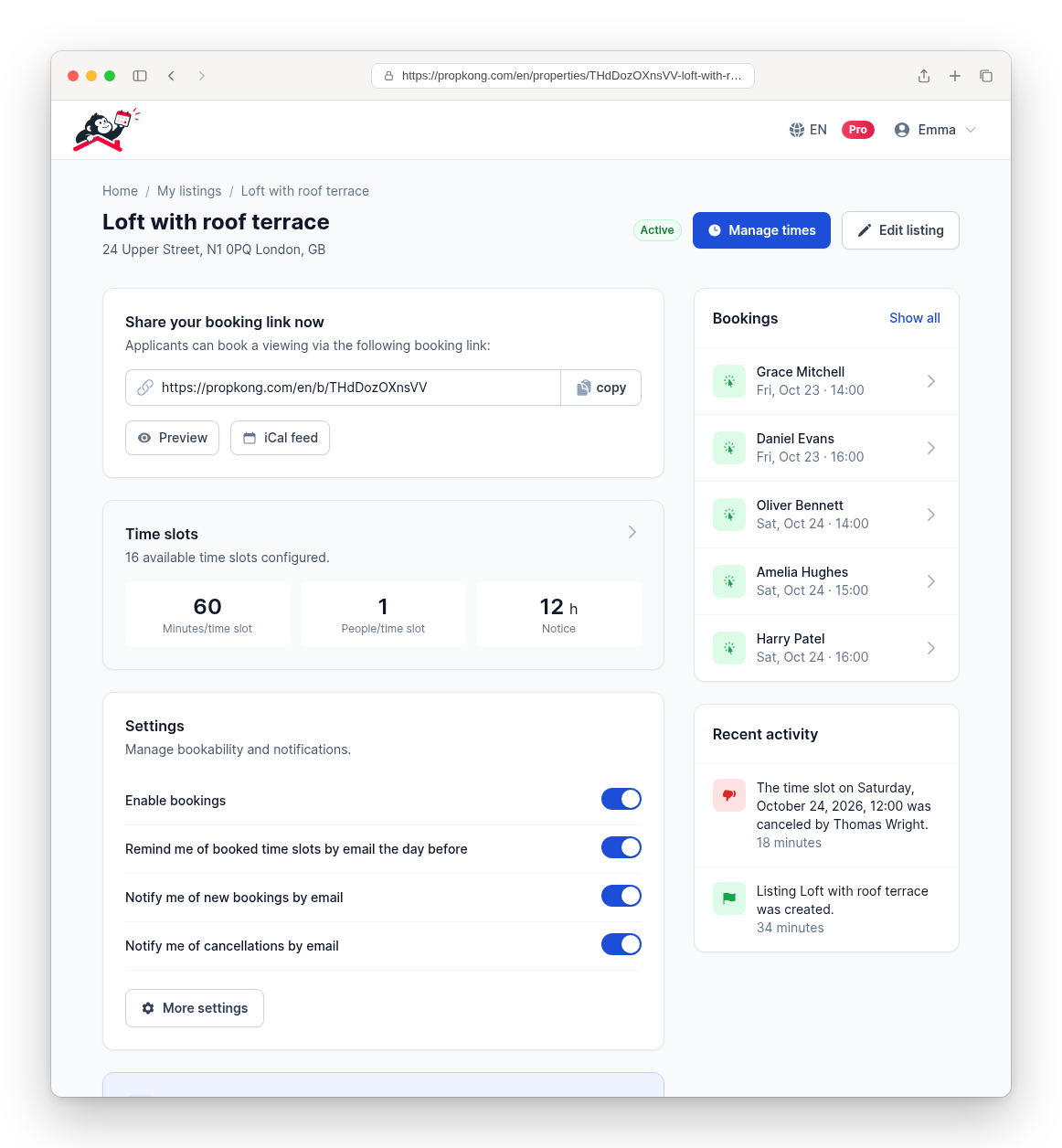
You do not need to solve this with spreadsheets and paper lists. With an online booking system, applicants sign up for open time slots themselves. You see at a glance how many people are coming to each round, full slots close automatically, and applicants receive a reminder the day before. With PropKong, you can set up bookable showing slots for an apartment or a house in a few minutes and receive a clear list of all attendees. Your first listing is free; after that, each additional listing costs €4.90, or €19.90 per month with Pro.
Unregistered walk-ins will happen. Plan two or three extra places per slot, give registered applicants priority and ask walk-ins to wait for the next round with space. Treating registered people first is fair and encourages reliable sign-ups in the future.
Follow-up should happen right after the showing, while impressions are fresh. Take notes on every applicant who left a good impression or brought complete documents, review applications against your criteria, and contact your top candidates within two to three days. Good applicants often have several options and will not wait long.
Common mistakes to avoid
Even experienced landlords make the same mistakes with group showings.
Too many people at once. When 15 people squeeze through a 550-square-foot apartment at the same time, nobody can see anything and you are flooded with questions. Stick to five to eight people per round.
No clear structure. "Feel free to look around" is not a showing. Without guidance, people wander, miss rooms or block the bathroom. Lead the group actively, even if the walkthrough is short.
No system for confirmations. Giving everyone the same time leads to unpleasant surprises: either everyone arrives at once or half of them forget. Use fixed time slots with automated reminders.
Missing materials. "I'll email you the details" costs you time later and looks unprepared. Print enough copies and keep forms within reach.
No follow-up. Postponing the review until "tomorrow" means losing the best applicants to other landlords. Block 30 to 60 minutes directly after the showing.
Inconsistent treatment and careless data handling. Give every applicant the same information and apply the same criteria to everyone. Fair housing laws, such as the Fair Housing Act in the US, prohibit treating applicants differently based on protected characteristics. Applications also contain sensitive personal data: do not leave them lying around, do not use sign-in sheets where everyone can read everyone else's contact details, and securely destroy documents you no longer need.
Conclusion
A rental open house does not have to be stressful. With careful preparation, clear time slots and a structured way of managing applicants, it becomes an efficient tool that saves you many hours. Plan five to eight people per round and 15 to 20 minutes per slot, prepare fact sheets and application forms, let applicants book their slot online instead of coordinating by email, lead each group through the unit, and review applications the same day so you can contact your favorites quickly.